 maskwire
Sign in ↗
maskwire
Sign in ↗ Email proxy vs. email forwarding
"Email alias" tools all sound similar from the outside: hide your real address, cut down on spam, keep control over who can reach you. But there are two structurally different ways to build one, and which kind you're using changes where your mail actually lives.
What forwarding services do
Services like SimpleLogin, addy.io, and Firefox Relay work by giving you a new, disposable address. Mail sent to that address is forwarded on: to your real inbox, or to a webmail interface the service hosts for you. When you reply, the message usually goes back out through their relay too, so your real address never shows up on either end.
That's a genuinely good model for handing an address to a site you don't trust yet. If it starts selling the address to spammers, you kill that one alias and nothing else changes.
What a transparent proxy does instead
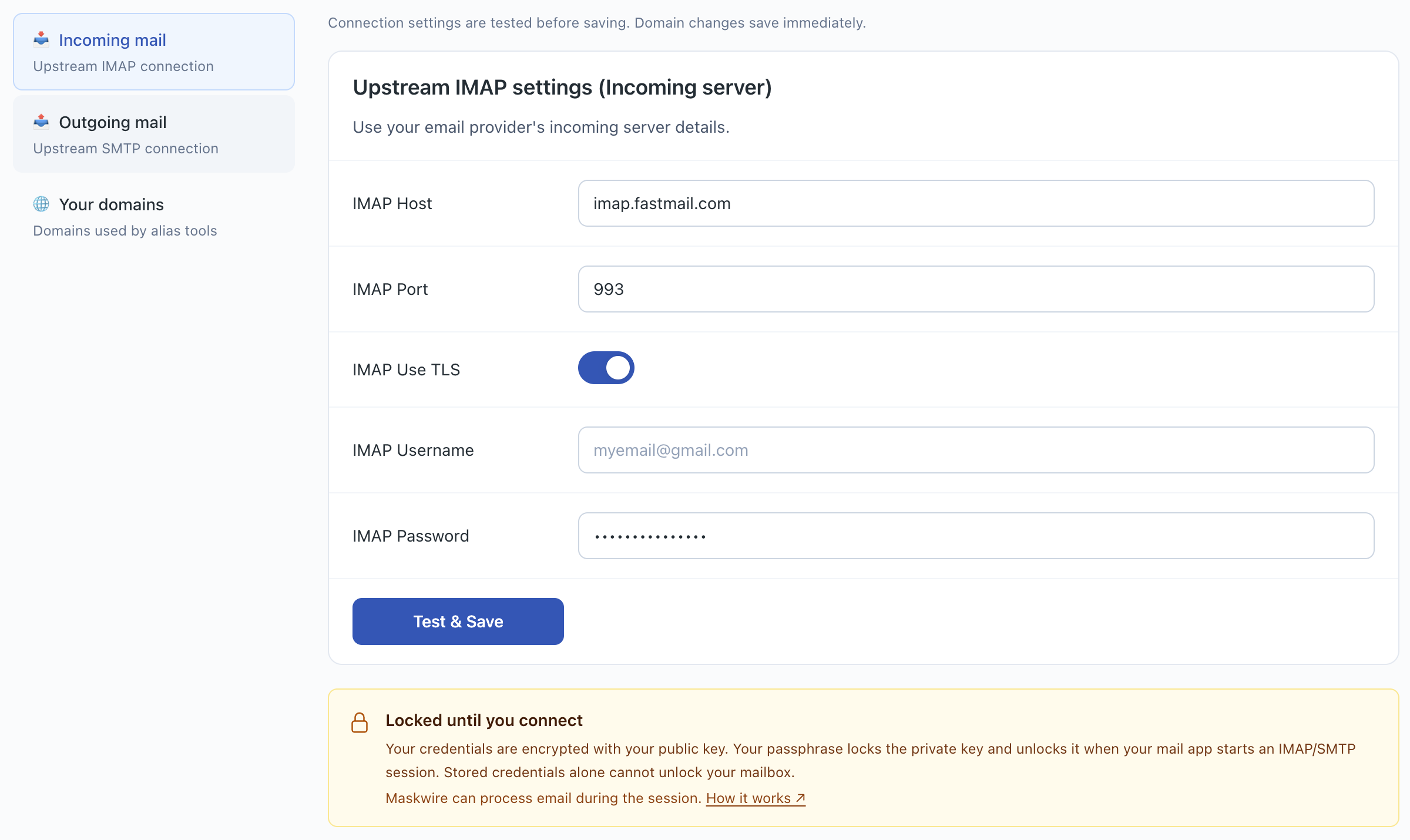
Maskwire doesn't create a separate inbox. Your client connects to Maskwire, and Maskwire opens its own connection to your real mail server on your behalf, rewriting messages as they cross from one side to the other. That's still two connections under the hood, not one continuous pipe, but from your side it looks like a single mail server: there's no separate address book of aliases to maintain in a dashboard, since it works on whatever your mail server already receives.
Instead, it works on top of whatever your mail server already receives, catch-all domains included, and changes what happens to messages as they move through your account: redacting patterns you don't want to send, rewriting who a reply appears to come from, catching a message you moved to Trash by mistake. Point your client at Maskwire's servers instead of your provider's, and everything else about your workflow stays the same.
What each is actually good at
Forwarding services are hard to beat for handing out one-off addresses to third parties you want to be able to cut off individually, without touching anything else.
A transparent proxy is the better fit when you want a change to apply across your whole mailbox in real time, rather than a growing list of aliases to manage one at a time in a separate dashboard.
They're not mutually exclusive
Nothing about running Maskwire in front of a mailbox stops you from also using your provider's own aliasing, or a forwarding service, on the same address. They solve different parts of the problem and can sit on top of each other.
See how the rewriting itself works
Read how sender rewriting and alias-reply restoration keep a reply going out under the right address.